An AI Idea I Couldn't Build in 2013
The question I was asking in 2013 is still worth answering in 2026.
This Diwali, while spending time at home, I was going through my personal library when I came across something I hadn’t looked at in years: a research paper I had written during my university days in 2013.
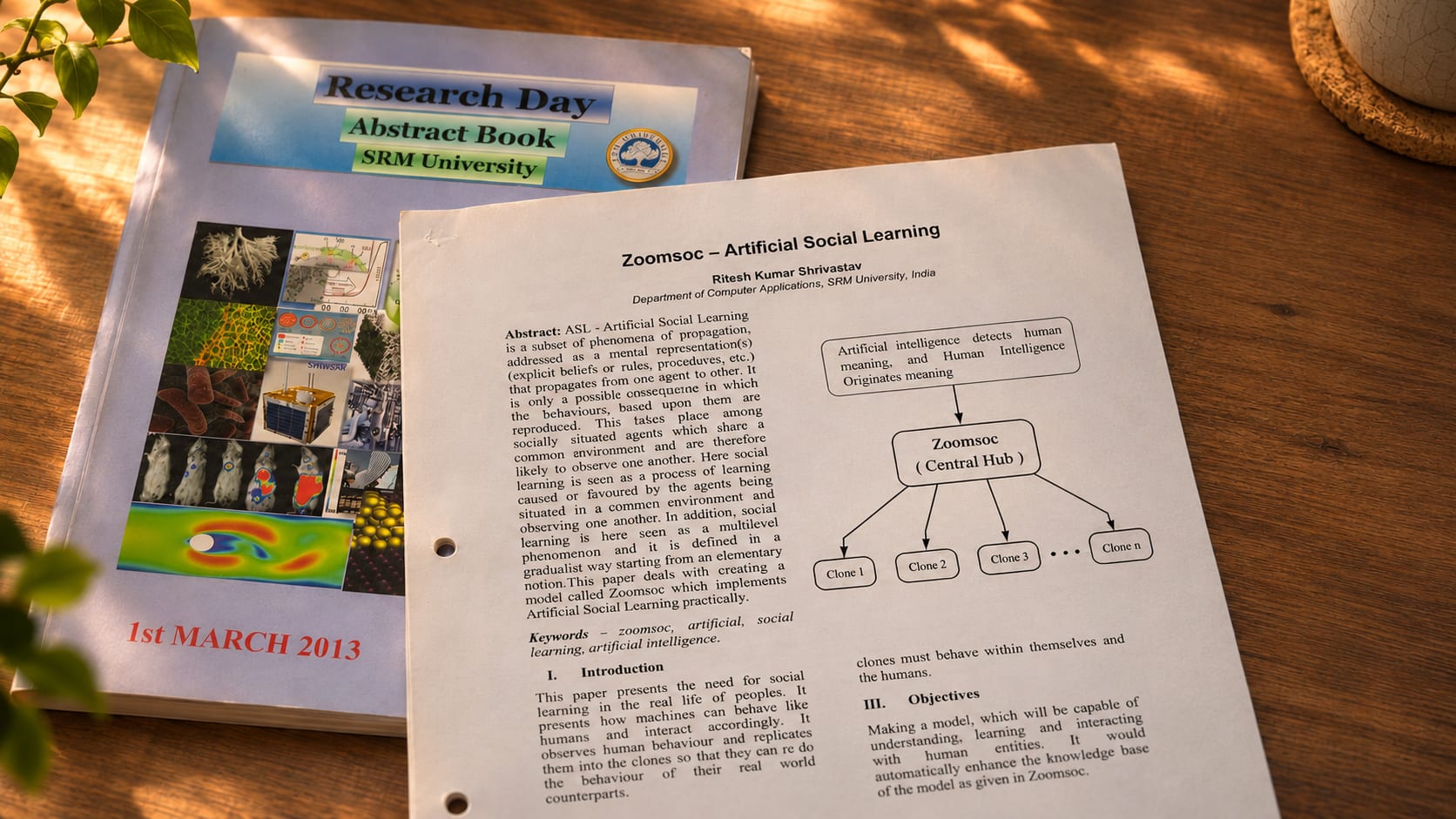
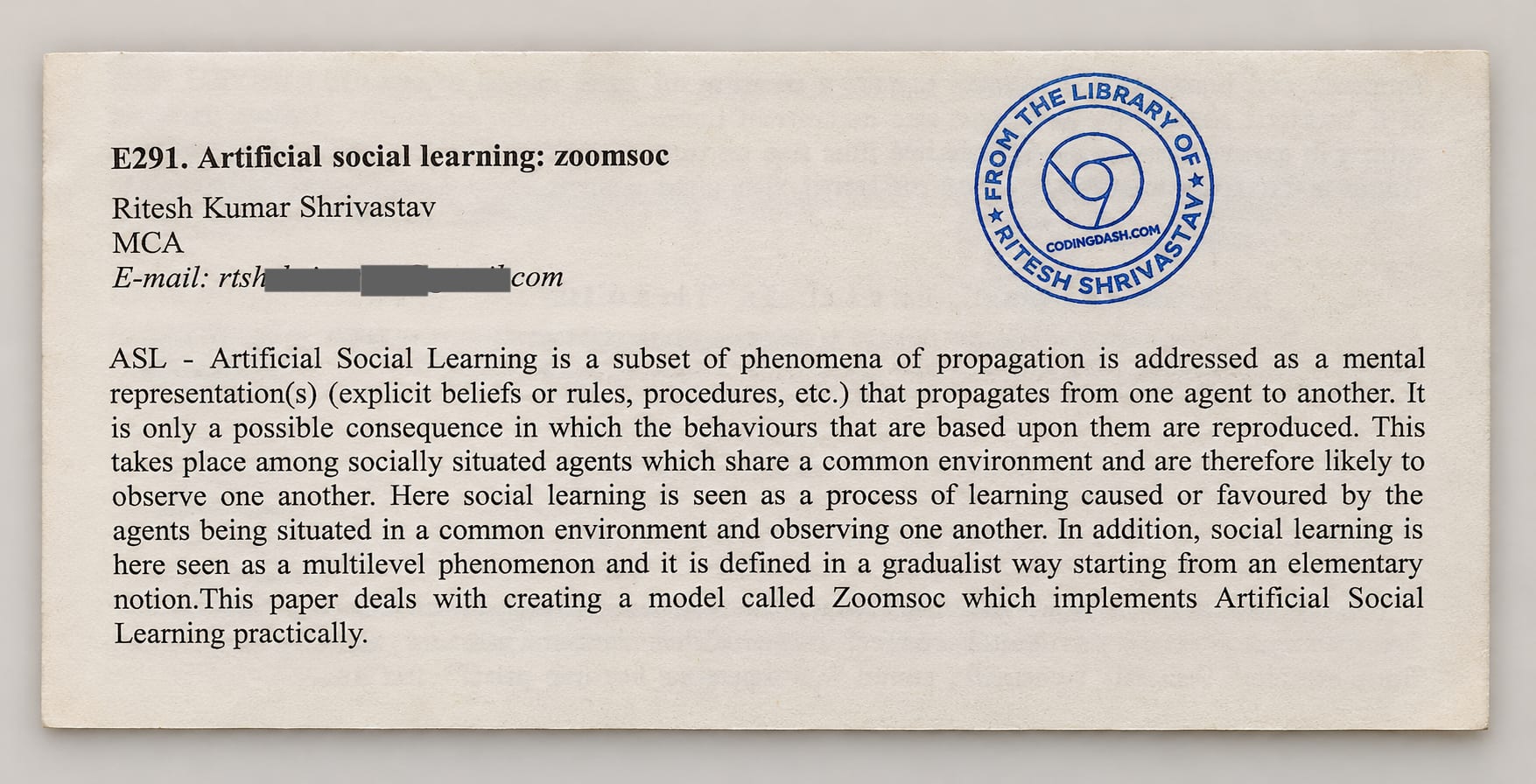
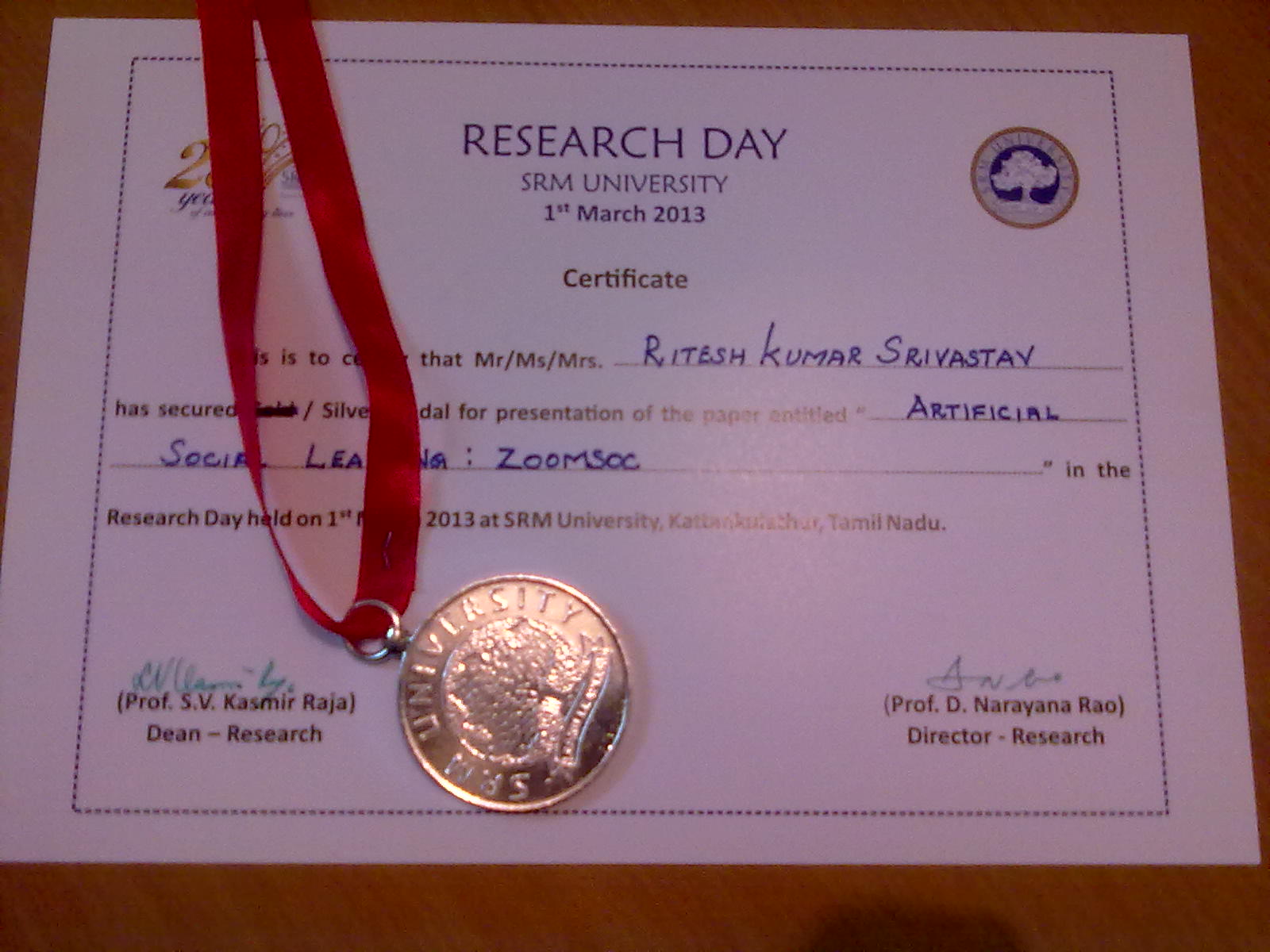
It was titled Zoomsoc: Artificial Social Learning. Its abstract had been published in SRM University’s Research Day Abstract Book in March 2013, and the presentation had earned me a silver medal.
Reading it after thirteen years was an interesting experience. Some ideas felt surprisingly relevant to what we are building with AI today. Others reminded me how little I understood about the complexity of the problem back then.
But what caught my attention wasn’t the technology or the architecture I had proposed. It was the question I was trying to answer.
Why should every individual have to learn everything through their own experiences when so much knowledge already exists in the experiences of others?
That question was the starting point for Zoomsoc.
The Idea Behind Zoomsoc
Human knowledge is largely accumulated through experience. We learn by observing, experimenting, making mistakes, and interacting with others.
But much of that knowledge remains confined to individuals.
In engineering, we frequently encounter this problem. An engineer spends days investigating a production issue, eventually discovering an unexpected interaction between two systems. The incident gets resolved, but much of the reasoning behind the investigation remains with that individual. Months later, another engineer encounters a similar problem and starts almost from scratch.
Not everything we learn gets documented, and even when it does, the context behind our decisions is often lost.
I wondered whether machines could help bridge this gap.
I called the project Zoomsoc, short for “Zoom and Shine Openly in the Crowd.” It was a name I came up with during my university days, when I was exploring how individual experiences could contribute to collective intelligence.
The idea behind Zoomsoc was to create an artificial environment populated by digital representations of real people. I called these representations clones.
Each clone would learn from the experiences and interactions of its human counterpart. The clones would also interact with one another, exchanging knowledge and collectively contributing to a shared intelligence system.
Over time, the system would accumulate knowledge from many individuals and make that collective experience available to others.
The objective wasn’t to reproduce human consciousness or create machines indistinguishable from people.
It was to make individual experiences collectively useful.
The underlying hypothesis was that knowledge accumulated across many individuals could help others make better decisions without requiring everyone to repeat the same learning process.
What I Proposed
The architecture was built around a shared intelligence system connected to multiple digital clones.
Each clone represented an individual and contributed knowledge acquired through interactions and experiences. The central system would combine information from these different sources and use it to respond to human queries.
I also explored how the system could learn continuously rather than rely entirely on predefined knowledge.
One section of the paper was titled Intelligence from Many Diverse Methods. It outlined three principles:
- Consider multiple algorithms because no single approach is perfect.
- Generate multiple hypotheses rather than committing too early.
- Analyse evidence from different perspectives.
Looking back, these principles were probably more interesting than the architecture itself. The goal was to avoid making intelligence dependent on a single source of information or one method of reasoning. The paper also discussed automated learning, where interactions with humans could help the system refine its understanding and test its assumptions.
Of course, describing these capabilities and implementing them are two very different things.
What I Actually Built
Not much, honestly.
The research remained largely a proposal, with some minor exploratory implementation.
There were several fundamental problems I hadn’t solved. How could a machine accurately capture someone’s experience? How would it distinguish knowledge from opinions or incorrect assumptions? What happens when two individuals have contradictory experiences? How could the system preserve context while transferring knowledge between people?
And perhaps most importantly, how would I measure whether the combined intelligence was actually better than the knowledge available from individual sources?
It’s also worth being precise about the originality of the idea. These concepts existed in artificial intelligence research long before my paper. I wasn’t inventing collective intelligence or predicting large language models. I was a university student exploring how existing ideas might be combined to solve a problem that interested me.
An architecture diagram can connect five components with arrows. Those arrows often hide the hardest engineering problems. Working on distributed systems over the years has made me much more conscious of that gap.
Over the years, I’ve learned that combining information from multiple sources is only part of the problem. The harder questions often involve preserving context, evaluating reliability, and understanding when that information should influence a decision. More information doesn’t necessarily lead to better decisions. Sometimes it only introduces more uncertainty.
An idea becomes valuable through the constraints it survives, the assumptions it validates, and the outcomes it produces.
Zoomsoc never reached that stage. It was an exploration, not a demonstrated solution, and I’m comfortable with that distinction.
Looking at the Same Problem in 2026
Fast-forward thirteen years.
We now have large language models capable of working with natural language, retrieval systems that can bring external knowledge into model interactions, and AI agents that can use tools, maintain context, and coordinate with other agents.
Several capabilities that were difficult for me to imagine implementing in 2013 are now accessible through relatively straightforward engineering.
Today, we can build agents equipped with specific knowledge, memory, and access to external information. Retrieval-augmented generation can make external knowledge accessible to a model. Multi-agent architectures can distribute work and combine specialised perspectives. Multiple agents can share findings and coordinate their work without requiring each one to possess the complete context.
This isn’t equivalent to the digital clones I had imagined in 2013. But there is a distinction worth making explicit. Accessing accumulated knowledge is different from learning from accumulated experience. Modern AI systems can retrieve and reason over what has been recorded, but that doesn’t necessarily mean they’re learning from experience. Continuous learning requires mechanisms for incorporating new information, validating it, and adapting future behaviour.
And sharing information is not the same as transferring understanding.
A system might retrieve thousands of experiences and still fail to recognise which ones apply to a particular situation. It might combine several convincing explanations into an answer that is fundamentally incorrect.
The questions of relevance, reliability, context, and evaluation remain important.
In that sense, today’s technology makes the problem more approachable, but it doesn’t make the problem disappear.
A Question That Stayed With Me
Looking back at my work over the years, I can see that certain questions have continued to interest me, even though the applications have changed.
In 2025, I explored an AI-powered system designed to learn from individual behavioural patterns and provide personalised guidance. More recently, I’ve built tools around connected planning and shared context, Stokik among them, exploring how information, decisions, and dependencies can remain accessible to both people and AI agents. Neither is a direct continuation of Zoomsoc.
But I find a common thread in the questions behind them: how do we stop knowledge from disappearing with the person who created it?
The specific answer changes with each project. The question doesn’t.
Perhaps these are simply the kinds of problems I naturally find interesting.
When Technology Catches Up With Curiosity
The boundary between what we can imagine and what we can implement keeps shifting. An idea that once required years of research and substantial infrastructure might eventually become practical through a few well-designed components. At the same time, technologies that remove one set of constraints often expose entirely new ones.
Today’s AI makes it easier to build systems that combine knowledge from many sources. But ensuring that knowledge is accurate, relevant, trustworthy, and useful remains difficult.
We can build agents that communicate with one another. That doesn’t guarantee their collaboration will produce better reasoning. We can give models access to memory. That doesn’t guarantee they’ll remember the right things or interpret them correctly.
There is also a harder objection worth acknowledging. Some knowledge may simply resist transfer. The understanding an engineer develops through years of working with a particular system often depends on being present for the decisions, the failures, and the context that never made it into any document. Attempting to capture and reuse that knowledge without its original context risks producing answers that appear useful but lead to incorrect conclusions.
If that’s true, the difficulty isn’t just engineering. It’s a more fundamental question about what makes knowledge useful in the first place.
These distinctions matter because the availability of technology should not be confused with the solution to a problem.
I understand that much better today than I did in 2013.
What an Unfinished Idea Taught Me
I don’t know whether I’ll ever revisit Zoomsoc as a project. If I did, I’d almost certainly approach it differently. The architecture would change, the assumptions would need testing, and the scope would probably be much smaller.
But I wouldn’t change the original question.
Why should valuable knowledge remain isolated when it could help others?
It’s a problem we encounter in engineering teams, organisations, and everyday decision-making. People solve problems, accumulate experience, and move on. Others encounter similar situations and repeat much of the same journey.
Documentation, mentorship, and communication help, but transferring experience and context remains difficult.
Perhaps AI will make it easier to preserve and reuse more of that knowledge. Perhaps the hardest challenges will turn out to be human rather than technological.
Finding this thirteen-year-old paper reminded me that not every idea needs to become a product to be meaningful. Some ideas shape the questions we continue asking, even when we don’t realise it.
Maybe the most interesting thing about revisiting an old idea isn’t discovering whether you were right. It’s realising that the question you were asking is still worth answering.