The Systems Behind Engineering Velocity
How we improved engineering velocity and infrastructure efficiency by building better systems around engineers and AI tools.
In 2026, an AI tool suggested a new state transition in our payment collection code. The suggestion was architecturally plausible, syntactically clean, and wrong. It violated a constraint we maintain around mandate state for regulatory reasons, documented in a design file the model had never seen. We caught it in review. But it was the third time in a month something like this had happened, and catching things in review is expensive compared to not generating them in the first place.
The model was not the problem. The environment was.
The challenge goes beyond AI-generated code. In systems that handle financial transactions, a seemingly small change can have consequences across services, integrations, and business workflows. Understanding the code is only part of the job. Understanding why it works the way it does is equally important.
At Jodo, we’ve been dealing with this complexity as our platform has grown. We started in 2020, working primarily with educational businesses, and over six years have partnered with over 5,000 institutes. In 2025, we launched Collect, a platform for other businesses, and have since partnered with over 12,000 merchants who use it daily.
Our platform handles payment collections, financial workflows, partner integrations, and the operational infrastructure underneath all of it. At the beginning of 2026, we were processing around 12 million platform requests per month. That number grew to 26 million as the year progressed. The growth was not unexpected. What we needed to work out was how to handle it without a proportional increase in the engineering team, infrastructure costs, or operational complexity.
We operate with a lean engineering team, so increasing capacity cannot depend on hiring alone. We needed to improve the systems through which engineers work, allowing the team to handle greater scale without a proportional increase in operational effort. That framing shaped what we chose to build in 2026.
Two initiatives came out of it. One was a platform for making AI-assisted engineering more consistent and effective across the team, which we eventually made public as Stokik. The other was an ephemeral infrastructure framework that lets developers provision and destroy development environments without needing deep infrastructure knowledge. The engineering work in both cases is in the details of what actually makes them function, and in figuring out those details while continuing to ship product and keep production running.
The Gap Between Capability and Usefulness
By 2025, AI coding tools were capable enough to help with real engineering work. We were using them. They improved individual productivity on well-defined tasks. The problem we kept noticing was not the models. It was everything around the models.
A model that understands Python does not understand Jodo. It does not know which of our services have hard latency requirements and which can tolerate more variance. It does not know that a particular database table has been append-only since 2021 for reasons not visible in the schema. It does not know our deployment process, our testing conventions, our review expectations, or the specific ways we handle error states in financial transactions. This knowledge is not documented in a single place. It lives in repositories, in past pull request discussions, in Confluence pages of varying currency, and in engineers’ heads. When a new engineer joins, they absorb it over months. When an AI tool joins the workflow, it absorbs none of it. Each session starts from zero.
The result was predictable in hindsight. Output quality varied not because the models changed, but because the context varied. When an engineer gave the model a detailed picture of what they were building, within what constraints, following which conventions, the output was useful. When the context was thin, the output was technically plausible and subtly wrong in ways that only surfaced during review. The engineers who invested time assembling context got better results. The ones who did not got worse results. Neither had a mechanism to make that effort reusable. The next session, the next task, the next engineer: start over.
This gap is larger than most people expect when they first start using AI coding tools, because the tools are good enough to make it feel smaller than it is. You get useful output often enough that you do not immediately see the pattern. The sessions that required heavy revision were the sessions where the context was thin. When you notice the pattern, you start thinking about what surrounds the model, not just what the model can do. That surrounding is what we mean by a harness.
Building the Harness
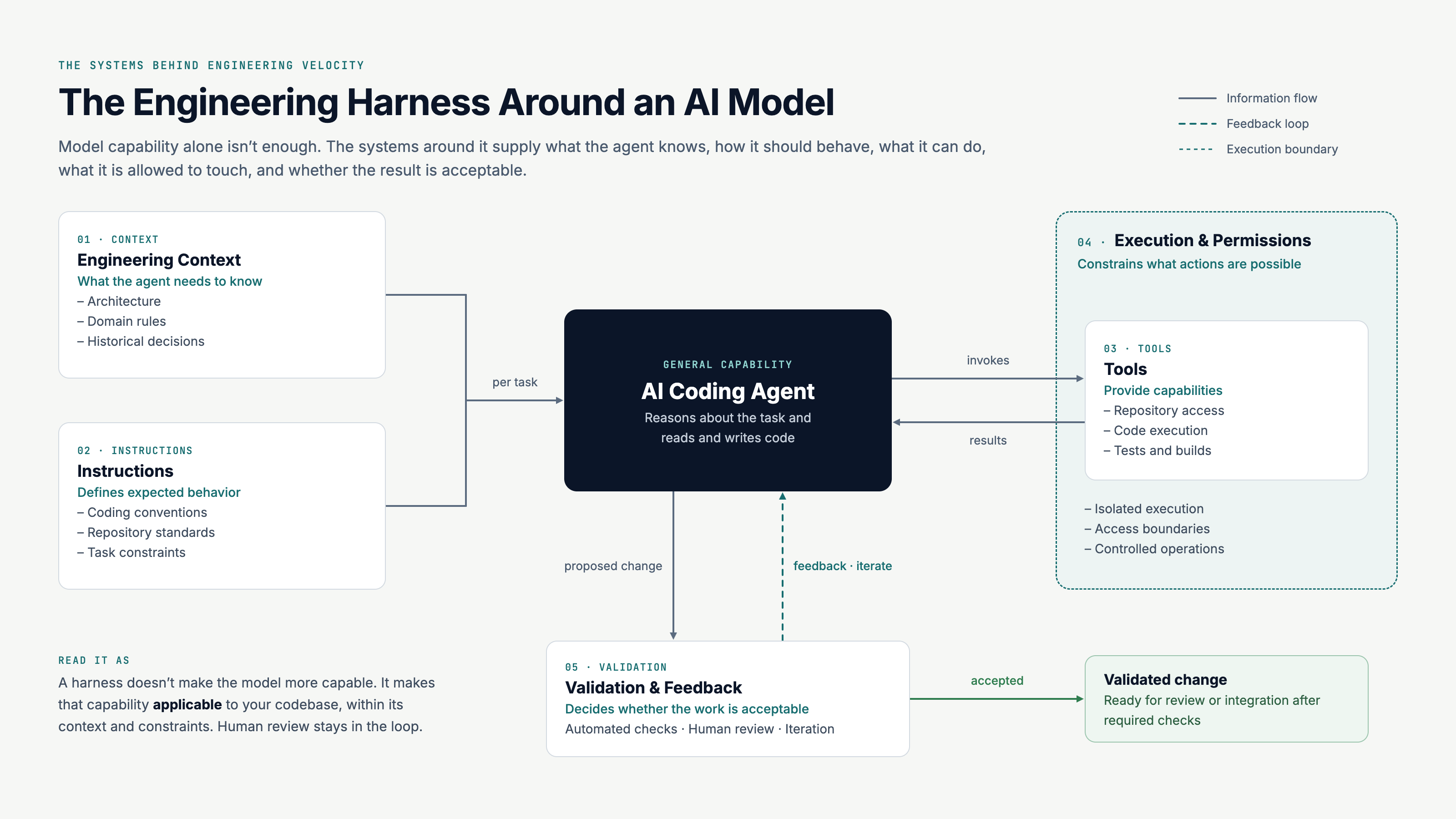
Harness is a useful word for this because it describes the relationship correctly. A horse harness does not make the horse stronger. It makes the horse’s strength applicable to pulling a cart. An AI harness does not make the model more capable. It makes the model’s capability applicable to your specific engineering problems.
What that requires, we discovered by running into the absence of each piece.
We started with the simplest fix: relevant context. If the model did not know about our architecture and domain constraints, we would tell it. This meant pasting in relevant files, describing service boundaries, explaining the constraints behind our payment state machine. It worked better than nothing. The state transition problem I described at the start of this article stopped appearing. The model’s suggestions became noticeably more grounded.
But it was expensive. Each engineer assembled context in their own way, to their own depth. The variance in output quality dropped compared to no context at all, but it was still significant. And there was no mechanism to share improvements. If one engineer figured out a better way to describe the payment service architecture to a model, that discovery stayed with them.
We also ran into a second problem the context fix did not address. Even with good context, the model did not know what good output looked like in our codebase. Context tells the model what exists. It does not tell it what we consider correct. We have specific conventions around how we write tests, how we handle errors in service calls, how we structure queries for our ORM. When these conventions were absent, the model’s output was often technically correct and still needed revision before passing review. We were spending review cycles on convention violations that should not have made it to review in the first place. We added explicit instructions to the context: not just descriptions of the codebase but rules about what we expected. Review cycles shortened noticeably.
As we started using AI assistance for more complex tasks, a third problem emerged. A model that can read and write code but cannot run tests cannot verify its own output. It makes suggestions and relies on the engineer to discover whether they work. When the model had access to the test runner, it could iterate on its own output before handing it over. The engineering benefit was real. But tool access that is too broad creates its own risk. A model with write access to the database can corrupt data through ordinary mistakes, through misunderstood instructions, through reasoning correctly within an incorrect context. The right scope of tool access per task type became its own calibration problem, and we were recalibrating it constantly.
Tool access also forced us to think more carefully about execution scope. What can the model physically reach? This is distinct from what it is instructed to do, and the distinction matters. A model that is physically incapable of modifying production systems is safer than one that can but has been told not to. In a fintech environment, where incorrect changes to production can have downstream financial consequences, layering physical constraints with explicit permission rules handles the cases where the instructions are misunderstood or out of date.
The validation problem looked different. For small, contained tasks, a developer can review model output at a glance. For larger tasks that touch multiple components, the review burden grows faster than the task complexity. The model might produce correct code in every individual component while introducing an inconsistency between components that only appears at integration time. We made validation manageable for the task sizes we routinely work with. We have not solved it at scale.
What none of these fixes addressed was reusability. Each improvement we made, to context quality, to instructions, to tool configurations, existed in one engineer’s setup. When a new engineer joined, they started from a blank slate. When a convention changed, we updated the instructions for whoever had thought to do it. The bottleneck had shifted: it was no longer that the model could not help with our codebase, it was that the conditions under which it helped well could not be reliably reproduced across the team.
This is the problem Stokik was built to solve.
The Context Maintenance Problem
One thing that did not come up in our original thinking, and became significant in practice, was context drift. A context definition describes the codebase at a point in time. The codebase changes. The description becomes inaccurate. An inaccurate description is worse than no description: it causes the model to reason confidently about structure that no longer exists.
Keeping context current is an ongoing maintenance task. We underestimated this. The discipline required is not dissimilar to documentation maintenance, with the same failure modes: it feels less urgent than shipping features, it falls behind during busy periods, and the cost of falling behind is not always immediately visible. You notice it when a model starts producing suggestions that would have been correct three months ago and are wrong now.
What works better than updating context on a schedule is triggering context reviews at the moments when the underlying reality changes. A service boundary shifts: update the context that describes it. A convention changes in a code review discussion: update the instruction that encodes it. This requires that engineers see context definitions as living artifacts rather than one-time setup work. Building that habit took longer than building the tooling.
The other thing that helped was reducing the blast radius of stale context. If every task inherits the full organizational context, stale information in one area affects all tasks. If context is composed narrowly, stale information in one area only affects tasks that explicitly include it. We moved toward narrower, more targeted context definitions over time, which made both maintenance and stale-context debugging more manageable.
Stokik
Stokik is the platform that emerged from this work. It is now publicly available at stokik.com. It focuses on the context management and reusability layer of the harness: the piece we found most underserved by existing tooling and most consequential for moving from individual productivity to organizational capability. The other components of a good harness, execution scoping, tool permissions, validation infrastructure, depend on how the model is integrated into the engineering workflow and vary by setup.
The core design is around context as a managed artifact. A team defines what a model needs to know to work effectively in a given area: service architecture, domain constraints, conventions, the non-obvious behaviors that exist for specific reasons. These definitions are versioned. They compose: a task working in the payment service automatically inherits both the payment-service-specific context and the organization-wide context, without the engineer assembling that combination manually. When a convention changes, you update the instruction that encodes it once, and the change propagates to every workflow that includes it.
What this means in practice is that the model’s starting point for any task reflects accumulated organizational knowledge rather than whatever the engineer happened to explain that session. A new engineer inherits the same context quality as an experienced one. An improvement one engineer makes to the context for a workflow benefits every engineer using that workflow. The sharing layer matters as much as the definition layer. Context that is well-defined but private to one engineer solves the individual problem but not the organizational one.
Going from individual usage to organizational capability required a shift in how we thought about context. Documentation is often treated as something you write once. Engineering infrastructure, on the other hand, is expected to be maintained, monitored, and treated as a system with failure modes. The context definitions in Stokik are infrastructure. They break in predictable ways when the codebase changes and the definitions do not. Treating them as infrastructure means allocating time for maintenance, having a signal when they degrade, and fixing them when they do.
Measuring What Changed
Measuring engineering velocity honestly is harder than it sounds. The obvious metric is code output: lines written, commits made, PRs opened. This is the wrong metric. More code is not better engineering. Faster code that breaks things is not better engineering. The goal is reliable, correct, maintainable work from task intake to production, faster.
We explicitly decided not to track lines of code or commit frequency. Both can be gamed without improving anything, and tracking them creates incentives to optimize the metric rather than the outcome.
What we tracked instead: time from task start to review-ready, number of review cycle iterations before approval, time from approval to production, test coverage trends over time, and the rate of incidents attributable to recent changes. None of these is a perfect measurement. Each is a proxy for something we care about. Together they gave us a picture we could act on and that was hard to manipulate without actually improving engineering.
We also paid attention to developer experience signals that resist quantification: whether engineers were spending more time on work they found interesting versus mechanical, whether review comments pointed to substantive issues or convention violations that should not have made it to review, whether the cadence of blocking feedback was going up or down.
Across these measures, our engineering velocity reached approximately 150% of its previous baseline during 2026, representing a 50% improvement. This reflects the combined effect of AI assistance, build-time improvements, process changes, infrastructure investments, and service optimization work. We did not run a controlled experiment, so the improvement cannot be attributed to any single initiative.
What I am confident about is that AI-assisted engineering produced better results with the harness than without it, and the harness produced more consistent results when context was managed systematically than when it was not. The improvement was directional and clear, even if the precise attribution is not.
Developer Environments That Actually Work
The ephemeral infrastructure initiative started differently. There was no AI tool involved, no model misbehaving. The problem was simpler and more familiar: developers need environments to work in, and environments are expensive, complex, and risky to maintain.
What a useful development environment needs to be is close to production. Not just in terms of the services running, but in terms of data shape, messaging behavior, and cache state. When an environment diverges from production in any of these dimensions, you get failures that look like bugs in your code when they are actually bugs in your environment. You spend time debugging the wrong thing.
Our situation before this initiative was typical. Shared staging environments and individual development setups. Shared environments created contention: a schema migration one engineer was testing would break another engineer’s integration test run. Individual setups diverged from production over time, and the divergence was invisible until it caused a problem. The standard instinct is to give each developer a dedicated environment. The problems this creates are cost and operational complexity, and they compound fast.
A dedicated environment that runs continuously costs money proportional to its existence, not its use. An environment active for eight hours is idle the other sixteen. Summed across developers and QA engineers, across weeks and months, the waste is substantial. And creating a compliant environment at Jodo is not a simple task. VPC configuration, IAM policies, security group rules, encryption requirements, database setup. We should not expect every engineer to know these things. The situation we were in was one where developers wanted environments, infrastructure was difficult to provision correctly, and the gap was being bridged by DevOps requests that added latency to the development cycle.
What We Were Trying to Build
Before we built anything, we defined what a solution needed to accomplish. This first phase had three requirements that shaped every design decision.
The first was simplicity. The framework had to be usable without infrastructure knowledge. An engineer who has never touched Terraform or IAM should be able to get a working environment. If the tool requires a learning curve before it delivers value, most engineers will not use it. Adoption is not guaranteed by availability.
The second was cost efficiency. Environments should cost proportional to actual use, not to their existence. This meant ephemeral: spin up when needed, sunset when done.
The third was transparency to its users. An environment that is easy to spin up but opaque in its behavior does not get adopted. Engineers need to be able to reason about what they are running: what services are live, what state the database is in, how long the environment will last. Easy to provision is not enough if the engineer cannot tell what they have provisioned.
The tension these requirements create is in the abstraction design. If you abstract too much, you create a black box. Engineers cannot reason about what they have provisioned, they cannot debug it when it behaves unexpectedly, and they do not trust it enough to rely on it. If you abstract too little, you expose complexity that blocks adoption entirely.
The heuristic we used was: developers should understand what they are asking for, not how the request is fulfilled. When a developer provisions an environment, they should know what services are running in it, what state the database is in, and roughly how long it will live. They should not need to know which subnet it lives in or which IAM role manages its lifecycle. This distinction guided most of the design decisions in the abstraction layer.
What We Built
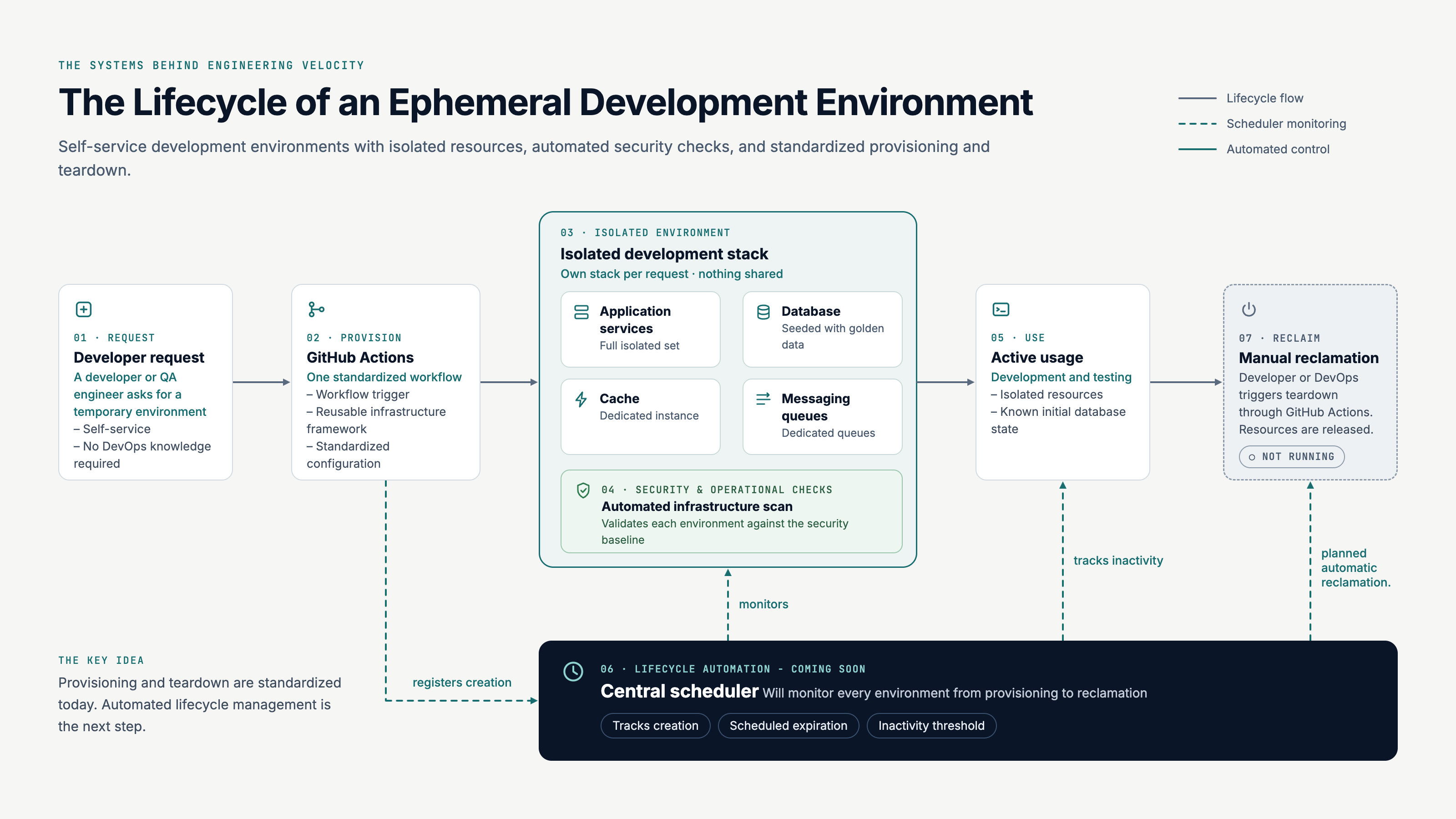
Each environment spins up with a fully isolated set of services, an isolated database seeded with golden data, a cache instance, and messaging queues. Nothing is shared between environments. A developer or QA engineer working in their environment is not affected by what anyone else is doing in theirs. The golden seed data means the database starts in a known, representative state rather than empty, so the environment is useful from the moment it is provisioned rather than after a manual setup step.
The framework scales to however many environments are needed at a given time, whether that is two developers working in parallel or a QA team validating a release. Each gets its own isolated stack. From a DevOps perspective, spinning up a new environment or sunsetting one is a single step, triggered through GitHub Actions. The complexity of what that step does, provisioning the services, seeding the database, wiring the queues, configuring the cache, is handled by the framework. The engineer triggering it does not see any of that.
Environment teardown currently happens through a manually triggered GitHub Actions workflow. While provisioning and cleanup are standardized, developers still need to initiate the process when an environment is no longer required. The next step is introducing a central scheduler to track environment lifetimes and automatically reclaim resources based on expiration and inactivity.
Infrastructure scanning runs against provisioned environments to validate them against our security baseline, without requiring a separate manual audit.
Standardized teardown makes cleanup straightforward, although eliminating idle infrastructure still depends on manual action. This remains one area where we can improve cost efficiency further.
What Changed
Our infrastructure optimization efforts helped us support a significantly larger platform without a proportional increase in infrastructure spending. Monthly platform requests grew by approximately 117%, from 12 million to 26 million, while infrastructure expenditure increased by approximately 12%.
The improvements came from several areas, including rightsizing resources based on actual usage, reducing unnecessary infrastructure consumption, and standardizing development environment provisioning and teardown. The ephemeral framework was one of these efforts, rather than the sole contributor.
Broader adoption happened, though slower than we expected. Developers who had previously worked through DevOps requests started provisioning environments directly. The pattern took time to establish. Some engineers needed to see that the environments actually worked, that the golden seed data was representative, that the services behaved correctly, before relying on them for real work. The adoption curve accelerated once a few engineers built ephemeral environments into their regular workflow and their velocity visibly improved. Demonstrated reliability matters more than documentation. Seeing a colleague move faster because they could spin up an isolated environment in a single step is more convincing than a wiki page explaining how to do it.
This is still a first phase. It addressed the immediate problems around cost, contention, and the DevOps bottleneck. It met the three requirements we set for it. What it did not yet attempt was giving developers real control over the environments beyond the defaults.
The Pattern
In both initiatives, the design question was the same: can recurring complexity be moved into a shared platform, so that engineers encounter it once rather than repeatedly? For Stokik, the complexity was engineering context. For ephemeral infrastructure, it was provisioning. Both platforms absorb that complexity and expose a simpler interface to the people using them.
What neither initiative could fully automate was adoption. Building context management tooling is a technical problem. Getting engineers to maintain context definitions as the codebase changes is an organizational problem. Building lifecycle automation for environments is a technical problem. Getting engineers comfortable with temporary environments, especially when considering automated reclamation, is a trust problem. The technical work was necessary but not sufficient in either case. The adoption work, the habit formation, the trust building, took longer than the platform work in both cases.
What We Still Don’t Know
The harness work substantially improved AI-assisted development for us. The velocity improvement is real. But the shape of AI-assisted engineering is still changing, and several things we have not solved are worth naming.
The hardest open problem is validation at scale. For small, contained tasks, a developer can review model output and verify it is correct. For larger tasks that touch multiple systems, the review burden grows faster than the task complexity. The model might produce correct code in every individual component while introducing an inconsistency across components that only appears at integration time. The right answer probably involves automated validation that goes beyond tests: behavioral checks, invariant verification, semantic consistency across system boundaries. We have not built that. The tasks we routinely use AI assistance for stay within the range where human review is tractable. As models become capable of handling larger tasks reliably, the validation problem will get more pressing before it gets easier.
The shape of AI-assisted engineering is also still changing. Models are more capable now than when we started. The tasks they handle reliably have expanded. Some of the scaffolding we built to compensate for model limitations may become unnecessary as models improve further. Some of it may become more necessary as the tasks get larger and more complex. We do not know which way that will go for each component, and we are unlikely to know until it happens.
The ephemeral infrastructure framework is in its first phase and works well for what it was designed to do. The harder questions come in the next phase, when developers have real control over service configuration and infrastructure variants. The defaults we have today encode reasonable choices for most cases. When developers can deviate from those defaults, they can also deviate in ways that break the cost and security properties the framework was built to guarantee. How to give developers meaningful configurability without undermining the guardrails is the design problem the next phase will have to answer.
We also have more to learn about measuring engineering productivity honestly. The 150% velocity figure is a compound metric. It reflects everything that changed during 2026, not just the AI harness work, not just the infrastructure work. We do not have clean attribution and probably never will, because engineering initiatives interact with each other and with everything else happening in an organization. What I would like to have, and do not yet, is a richer set of leading indicators that predict velocity changes before they appear in throughput numbers. Throughput is a lagging signal. By the time you see it, the conditions that produced it were set weeks or months earlier.
There is also a question we have not fully answered about organizational readiness. The harness tooling helps when engineers use it well. Using it well requires understanding what good context looks like, what clear instructions accomplish, and where model output should be trusted versus scrutinized. These are not skills every engineer has by default. We have done training and pair work to develop them. The right way to build organizational fluency with AI-assisted engineering at scale is not obvious to us yet.
Where Things Go From Here
Stokik is now publicly available. The patterns we developed internally are accessible to other engineering teams. Our experience at Jodo is a single data point in a space that is early, so we are curious to see what problems other teams bring to the context management and reusability questions.
The next version of the ephemeral infrastructure framework is about giving developers real control. The first phase gave everyone the same environment with sensible defaults. The next phase will let developers configure and tune specific services, set up stress test variants, and choose the infrastructure resources appropriate to what they are testing. The defaults stay as the starting point. The configurability is additive. We also plan to open-source selected components, once we have evaluated which parts are genuinely reusable versus which are specific to Jodo’s architecture.
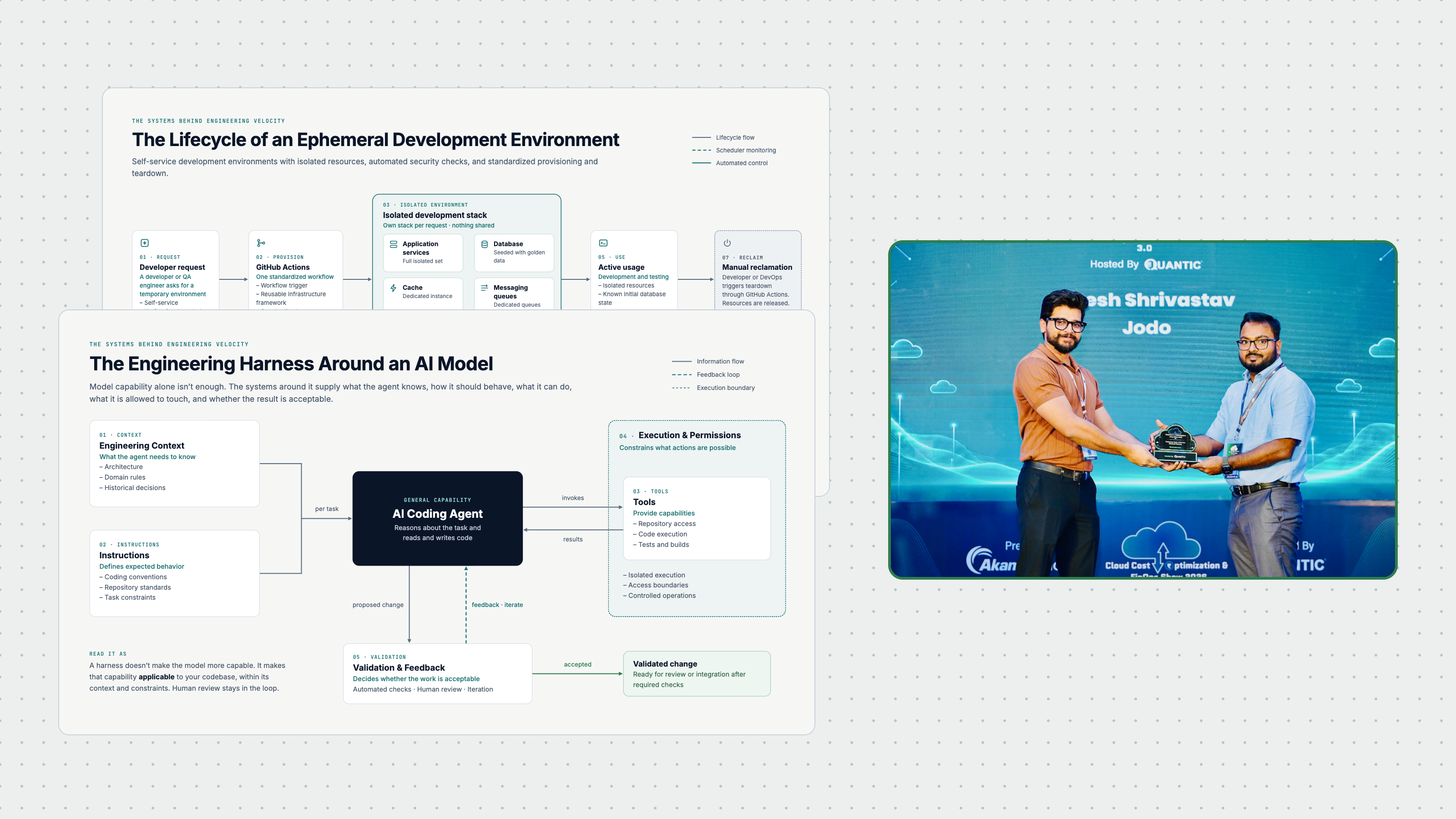
These engineering efforts were also recognized at the 3rd Edition Cloud Cost Optimization & FinOps Show 2026, where I received the Technology Leader of the Year award. It was a nice moment of recognition for the work we’ve been doing at Jodo around AI adoption, automation, and infrastructure efficiency.
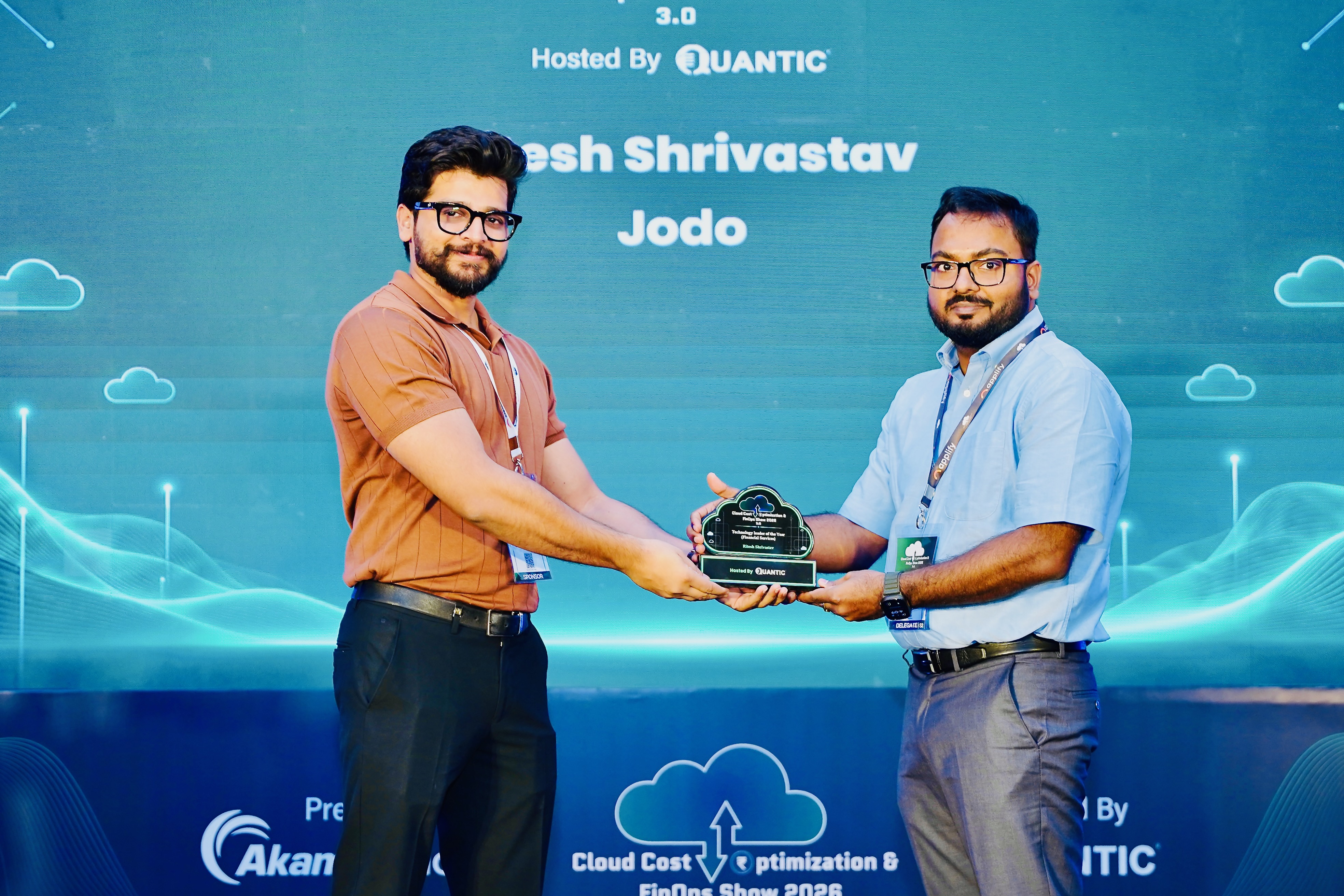
To the team building this alongside me every day — thank you for the execution, the feedback, and the improvements that made this work what it is.